
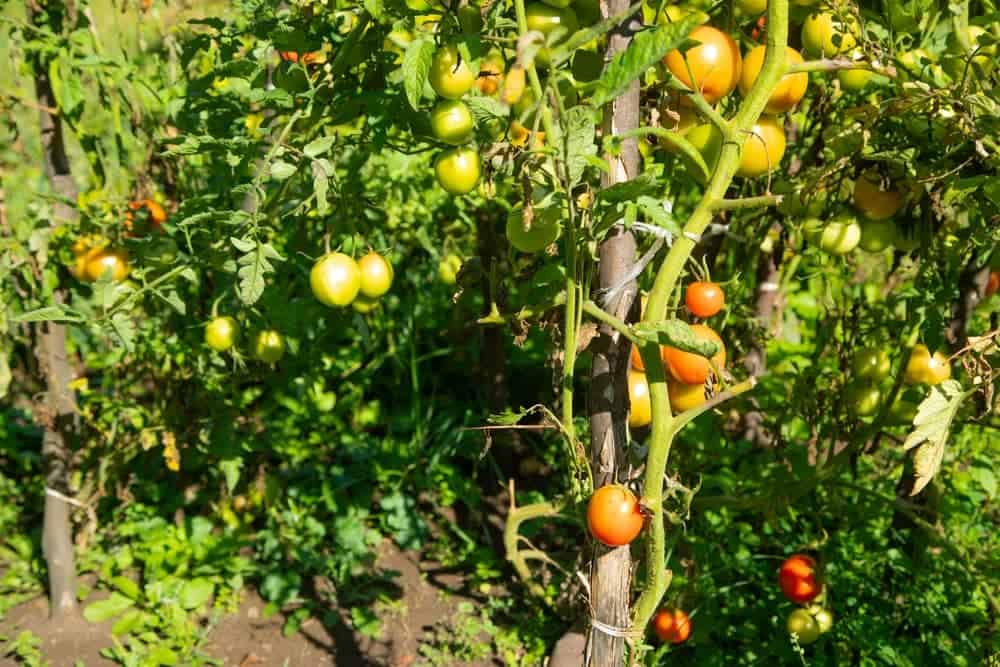
So you’ve just planted your tomato seedling, and it’s looking healthy and happy. Now, what’s next?
Beyond the usual plant care, like watering and fertilising, giving your tomatoes proper support is important.
Otherwise, the stems can droop and the branches can break, especially once the plants start producing fruit.
For determinate or bushy tomatoes, some light support is usually enough. But for indeterminate or vining plants, you’ll need taller, sturdier structures.
Whether you’re new to tomato gardening or looking for other ways to support your plants, this guide covers the best ways to support tomatoes and keep them thriving!
Do All Tomatoes Need Support? | When to Install Supports | Different Support Methods
Why Support Tomato Plants

Along with regular watering and fertilising, tomato plants need a sturdy support to thrive, particularly the indeterminate types!
These plants naturally sprawl, so without proper support, they’ll end up creeping along the ground.
That makes them more prone to common tomato diseases and pests that live in the soil.
On the other hand, a good support structure trains tomatoes to grow upright. This keeps leaves off the ground and leads to better air circulation.
Upright growth also makes pruning tomatoes much easier, which is essential for plant health.
And once the tomatoes start producing, their slender stems need help to hold the heavy fruits. Without support, the branches can snap, and the fruits may fall and split!
Do All Tomato Plants Need Support?
Not all tomato varieties need the same level of support, as different plants can have different growth habits.
Indeterminate tomatoes need extensive support from strong materials. But for most determinate plants, a lighter support is usually enough.
How to support determinate tomatoes
Determinate or bush-type tomatoes naturally stay compact, around 0.5—1.5m tall. They also produce fruit over a short period, typically within just 1–2 weeks.
Because of their size, they can usually stand on their own, especially very small varieties like ‘Tiny Tim’ or ‘Patio.’
Still, some support can be beneficial in case their stems get heavy with fruit. A stake or cage about 1–2m tall is usually enough for these plants.
How to support indeterminate tomatoes
Indeterminate or vining tomatoes sprawl and produce fruit continuously throughout the season.
They can also get heavy (sometimes up to 20kg with foliage and fruit), so they need tall and sturdy support!
Use structures that are at least 2–3 m tall and made from strong materials like hardwood or metal.
Your pruning method also dictates the support you’ll need.
If you’re pruning to only one stem, a lighter structure is usually enough. However, double or multi-stemmed plants need more extensive support to handle the extra weight.
Check the plants regularly to make sure their supports stay intact as they grow.
When to Set Up Support for Tomato Plants
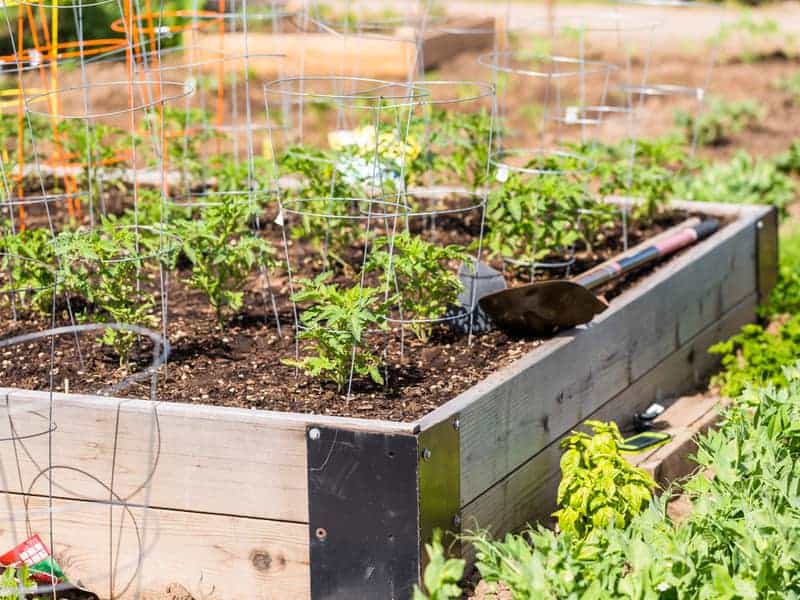
The best time to set up support is right after planting tomatoes in your garden bed or pot.
Installing the support structure early means you won’t disturb the tomatoes’ roots later when they’re already established.
Plus, you want to train the tomato seedling for upright growth early, so it can readily adapt to the support you’re setting up.
If you wait until the plant is too large, adding support will be too difficult, and you might end up damaging the stems and leaves.
What Are the Different Ways to Support Tomatoes in Australia?
If you’re wondering how to support tomato plants, you have plenty of options, such as:
- Stakes
- Cages
- Ladders
- Florida weave
- Vertical strings (aka overhead trellis)
- Wire grid trellis
The best way to support tomatoes depends on many factors, like the varieties you have, the location they’re growing in, and the pruning style you’ll use.
Also, think about the costs involved and how much time you’re willing to spend tending to your plants.
Once the support is in place, keep in mind that caring for your tomatoes can be demanding.
You’ll need to fertilise your tomatoes regularly, keep up with pruning, and check if they’re supported as they grow!
If you’re short on time, hiring a professional gardener can ensure that your tomato plants stay healthy and properly supported.
1. Supporting Tomato Plants with Stakes

Staking tomatoes is one of the simplest ways to keep your plants standing up. All you need is an upright post (or two) and some soft garden ties!
This method works best for determinate or bush tomatoes.
You can also stake indeterminate tomatoes, but make sure to prune them to one or two main stems only.
Pros and cons of staking tomatoes
Tomato stakes are affordable and easy to set up. They’re perfect for smaller spaces or if you’re growing tomatoes in pots.
The downside is that they require a lot of upkeep.
You’ll have to tie up the tomato stems regularly and check that the loops aren’t too tight as the stems grow thicker.
And if your plants are indeterminate, you’ll need to prune them more often, especially the suckers or side shoots. Otherwise, they can become too heavy for the stakes!
How to stake tomato plants
Not all tomato stakes are the same, so you need to choose the best type for your plants. Stakes are usually made from:
- Plastic: Weather-resistant but some types may be too flexible
- Hardwood: Durable but can rot if exposed to moisture for too long
- Bamboo stakes: Lightweight but can weaken after one or two growing seasons
- Metal T-posts: Very strong but can heat up under direct sunlight and scorch stems and leaves
Many gardeners go for wooden stakes (specifically hardwood), as they’re affordable and reusable.
Next, think about how many stakes you’ll need.
For determinate plants or indeterminate plants pruned to a single vine, one stake is usually enough.
For double-leader tomatoes, you’ll need two stakes on either side of the plant to support both vines.
When installing the stake, position it about 10–15 cm away from the main stem to avoid damaging the tomato roots.
Push it at least 30 cm deep into the soil, then give it a gentle shake to make sure it’s stable.
Then, bind the stem to the stake loosely using stretchy garden ties or strips of a soft cloth. Don’t use anything that can cut into the foliage or vines, such as jute or cotton twines.
Make sure there’s enough room in every loop so the stem can freely grow and thicken over time.
As your tomato plant grows, check it weekly. Add another tie for every 15–20cm of new growth to keep your tomato properly supported.
2. Supporting Tomato Plants with Cages
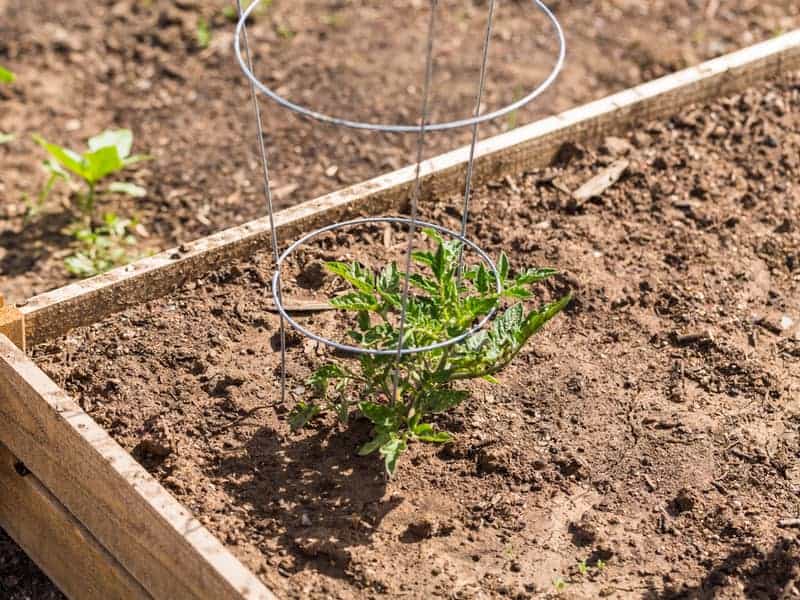
Tomato cages are usually cylindrical or square and made from wire or metal.
If you have determinate tomatoes, you can use standard-sized cages (usually 30–45cm wide and 1–1.5m tall) that you find in garden centres.
For indeterminate plants, you might need to make your own larger and sturdier cages.
Pros and cons of using tomato cages
Compared to stakes, cages are a lower-maintenance way to support tomato plants, since no tying is needed!
You also don’t need to prune as heavily as you would with staked plants.
Since cages offer more room, they’re perfect if you like to let your tomatoes develop two or more main stems.
However, cages can take up plenty of space, so they’re usually not the best choice for container tomatoes or smaller gardens.
And if you’re building your own tomato cage (particularly for tall, vining varieties), it can take a bit more time and effort to assemble.
That means they may not be the best option if you have multiple tomato plants!
How to use tomato cages
To use a cage, place it directly over the young tomato plant. Make sure the seedling sits right in the centre.
Push the legs or stakes of the cage firmly and deeply into the soil, then check that it’s stable.
If the cage is lightweight and your area is windy, you can reinforce it by binding it to a nearby structure.
(TIP: Some gardeners drive in a stake or a metal T-post beside the cage and tie them together to secure the structure in place.)
As the tomato plant grows, tuck the stems and leaves inside the cage so they rest naturally on the wires.
3. Supporting Tomato Plants with Ladders
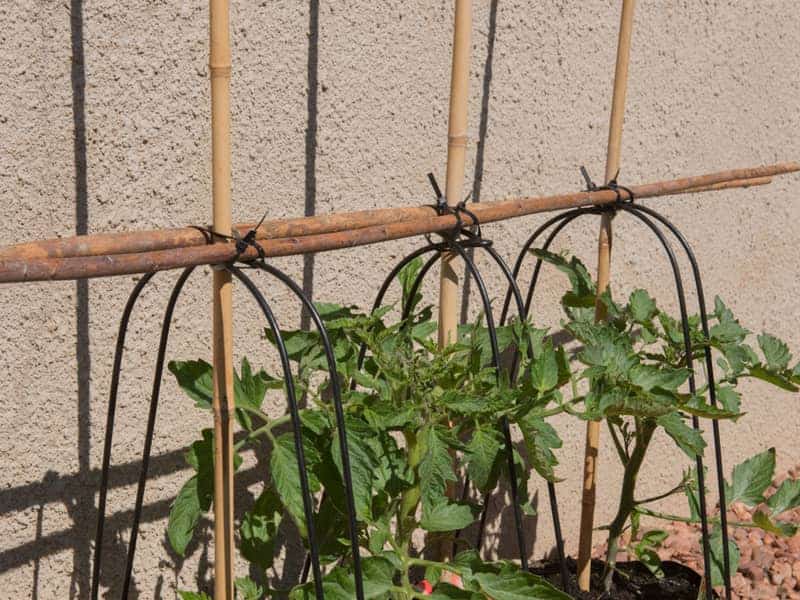
Tomato ladders or towers typically have 3 or 4 vertical rods connected by horizontal rungs. They form a tall, open-frame structure that tomatoes can climb.
You can use tomato ladders to support both determinate and indeterminate varieties.
However, many gardeners build their own ladders for indeterminate plants to ensure that the vines have enough space to grow.
Pros and cons of tomato ladders
If you’re only growing a few tomato plants, tomato ladders are a good choice. They’re easy to set up, remove, and reuse every season.
The narrow types can also work well for container tomatoes.
However, ready-made ladders can be more expensive than other supports, particularly those made from high-quality metal.
Also, some ladders might have a fixed height, so it might be tricky to extend them if your tomatoes outgrow the ladder.
While stackable or modular types are available, they may cost even more!
How to use a tomato ladder
Push the ladder’s legs deeply into the soil to keep it stable. Position it so that the tomato plant sits in the centre of the frame.
As the tomato grows, make sure its stems and branches stay inside the ladder.
For branches that start leaning outward, gently tuck them back in so they rest on the rungs.
If your plant gets too heavy with fruits, you can tie the main stem to the rungs with soft garden twine or plant clips.
In windy areas, drive a stake or two beside the ladder and tie them together for added stability.
4. Supporting Tomato Plants with the Florida Weave
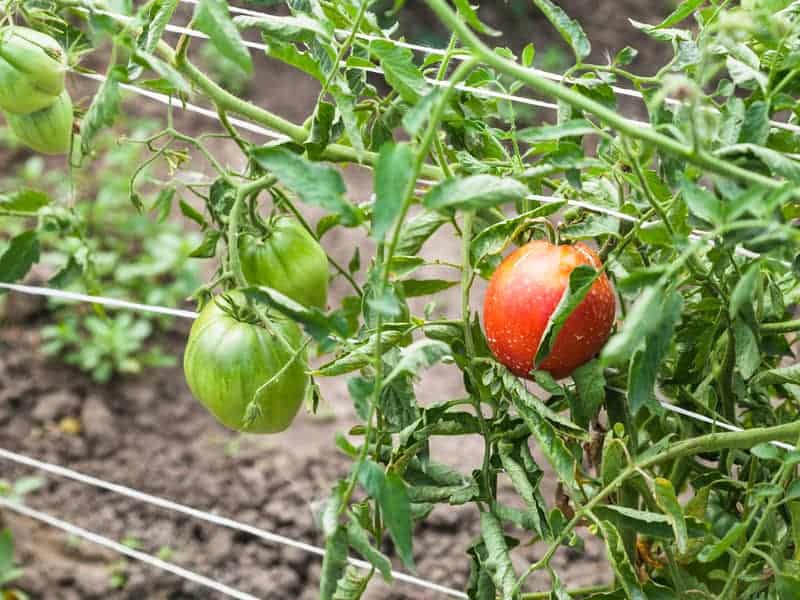
Got rows of tomato plants growing in your garden? Instead of using individual stakes or cages for support, try the Florida weave (aka basket weave)!
In this trellising method, twine is woven around stakes to gently hold the tomato plants upright.
It’s suitable for both determinate and indeterminate varieties.
Pros and cons of the Florida weave
The Florida weave method is cheap, easy to set up, and reusable every season.
Your tomato patch will also look neater, as you’re not installing individual supports (like bulky cages).
The open design also makes it easy to add supports (like stakes) when needed.
That said, it might not be a practical choice if you only have a couple of tomato plants, since you’ll need to keep adding new layers of twine over the season.
How to set up the Florida weave for tomato plants
Place sturdy stakes, such as metal T-posts or timber posts, at both ends of each tomato row. Push them at least 30cm deep into the soil.
Then, add a stake between every 2–3 plants along the row.
When your tomato plants are about 20–30cm tall, start your first weave.
Tightly tie the twine (jute, cotton, or synthetic garden twine) around the first stake on the edge of the row.
Run the twine along the row, placing it in front of one tomato plant, then behind the next one. Keep alternating as you go.
When you reach the next stake, wrap the twine tightly around it to make sure that the line is firm.
Then, run the twine along the other side of the row, following the same front-and-back pattern.
When you’re done, the tomato plants should be gently sandwiched between the “basket weave” you created.
As the plants keep growing, add another layer of twine for every 15–20cm of new height to keep them supported.
If you’re growing multi-stemmed tomatoes, keep an eye on them. They may need extra support, such as additional stakes, if the twine alone can’t hold them upright.
5. Supporting Tomato Plants with Vertical Strings

A great way to support tall tomato plants is with vertical strings, also called the drop line system or overhead trellis.
In this method, you’ll tie a twine to a horizontal pole suspended above the plants. Then, the tomato vines are trained to climb the string.
This trellising method works best for indeterminate tomatoes, as it’s not always the most practical choice for determinate types.
Pros and cons of vertical strings
Many gardeners love the vertical string trellis because it’s affordable and space-saving.
And once you’ve set it up, you can use it year after year, so it’s perfect if you grow tomatoes regularly.
The catch is that it takes some effort to build initially!
You’ll also need to check the strings and frame often to make sure they stay strong enough to hold up the heavy plants.
How to set up vertical strings to support tomatoes
Start by building a tall, sturdy frame.
Push a strong post (like a steel T-post or a wooden post) about 45–60cm deep into the ground at both ends of the tomato row. Each post should be about 2–3 m tall.
Next, attach a horizontal pole across the top of the posts. Secure all joints with bolts or nails so the frame doesn’t wobble.
Tie a strong nylon or polyester twine around the top beam. Avoid using natural jute strings, as they can weaken and snap over time.
Each string should be long enough to stretch from the top beam down to the base of the plant, with 20–30cm extra length for tying.
If you haven’t planted your tomatoes yet, tuck the bottom end of each string into the planting hole before lowering in the seedling.
The roots will anchor the string in place as the plant grows.
If the tomatoes are already in the ground, tie the bottom end of the string near the base of each stem instead.
(TIP: Instead of burying the string or tying it around the stem, you can attach a horizontal pole at the base of the frame, about 10cm above the ground. Then, tie the string around it!)
Then, as your tomatoes grow, use soft twine or plant clips to bind the main vine to the string every 15–20 cm of new growth.
Another option is to simply wind the vine around the string. Just don’t pull the plant too tightly to avoid damaging any parts of the plant.
If you’re growing multi-stemmed tomatoes, make sure to use a separate string for each main vine for proper support.
6. Supporting Tomato Plants with Wire Grids

A metal wire grid can make a sturdy tomato trellis, perfect for garden beds with long rows of plants.
It’s suitable for indeterminate varieties that need a lot of support, especially when they start to produce fruit!
Pros and cons of tomato wire grids
Wire grids are strong, durable, and reusable season after season, especially if they’re made from steel wire.
Once installed, they require little upkeep. You usually don’t need to tie the plants — simply guide the vines through the wires as they grow.
They’re ideal for supporting multiple plants or multi-stemmed tomatoes.
However, building a grid can take time and effort, and ready-made versions are usually more expensive than other types of supports.
How to set up a wire grid for tomato plants
If you’d rather not build a grid from scratch, you can use a wire panel or cattle panel from a hardware, garden, or farm supply store.
These ready-made grids are sturdy and strong enough to support large tomato plants and their fruit.
If your tomato patch is near a wall or fence, you can prop the panel against it. Secure it with hooks or brackets to keep it from slipping.
To make your own grid, drive two sturdy posts at both ends of each row of tomato plants. Bury them about 45–60cm deep into the ground.
Stretch metal wire between the posts, first horizontally then vertically, to create a grid that the plants can climb.
The grid openings should be about 15–20cm on each side. This gives tomato stems and branches enough space and makes it easy to weave them through.
As your tomatoes grow, gently weave the vines through the openings so they rest on the wires for support.
You can also tie them loosely to the wires using soft garden twine or plant clips.
Check new growth weekly, and continue guiding the stems through the grid openings to keep the whole plant upright!
More Ways to Support Tomato Plants
Looking for more tomato plant support methods? Try these options:
A-FRAME TRELLIS: This is a variation of the overhead trellis. Build an A-frame at each end of a tomato row, rather than using a single post. The angled frame provides a stronger support for the vertical strings.
TOMATO GRID ARCH: This is made from a wire or cattle panel bent into an arch, and can usually support two rows of tomatoes. Train the stems to climb up each side of the arch.
TOMATO SPIRALS: These are available at most garden centres. Push one deep into the soil beside each plant, then guide the main vine to grow around the spiral as the plant develops.
COMBINATION SETUPS: You can combine different supports for better stability. For example, add strings to cages, or reinforce ladders with extra stakes.
FAQs About Supporting Tomatoes

Proper support helps your tomato plants grow healthy and produce a bigger harvest.
Below, we answer the common questions about how to keep tomato plants well-supported!
Is it better to use tomato cages or stakes?
Both cages and stakes can keep your tomato plants upright, but the best choice depends on your variety and space.
Stakes can work well for both determinate and indeterminate varieties (those pruned to one or two main stems). They also work well in pots!
However, you’ll need to check your plants regularly and keep tying the vines to the stakes as they grow.
Cages, particularly standard ones from garden centres, are usually better for bush-type tomatoes.
They support the plant on all sides, so you typically don’t need to tie stems as often. This makes them a lower-maintenance option.
However, they can be too flimsy for tall, vining tomatoes, so some gardeners build their own cages.
Just keep in mind that if you have multiple plants, cages can take up a lot of space in your garden!
How to support tomatoes in pots
For container tomatoes, make sure the support structure will fit into the pot and won’t topple the plant over. You can use:
- Cages
- Stakes
- Spirals
- Ladders
How to support cherry tomatoes
It depends on the type you’re growing, as cherry tomatoes can be determinate or indeterminate.
Generally, though, their fruits are smaller and lighter, so they’re often easier to support.
You can use stakes, cages, or an overhead trellis system for your plants.
How to support beefsteak tomatoes
Since beefsteak tomatoes produce large, heavy fruit, use a very sturdy support made from hardwood or metal. Suitable ones include:
- Large, tall cages
- Customised ladders
- Wire grid trellises
Make sure the structure is deeply pushed into the ground (around 45–60cm) so that it’s stable.
Then, harvest the tomatoes as soon as they’re ripe or even earlier to keep the branches from snapping.
How to stop tomato plants from falling over
To keep your tomato plants from falling over, choose the right support suitable for the variety you’re growing.
Make sure the structure is buried deeply into the ground or securely attached to a wall or fence. After installing, double-check that it doesn’t wobble!
Then, monitor the plants regularly as they grow, and keep guiding the vines through the supports.
If needed, tie the main stems to the support with soft garden twine or plant clips.
For heavy or multi-stemmed tomatoes, add extra stakes or strings to handle the plants’ weight.
After strong winds or when the plants are heavy with fruit, check the supports and adjust any leaning branches.
Lastly, proper pruning can help keep the plants lighter and upright!
