
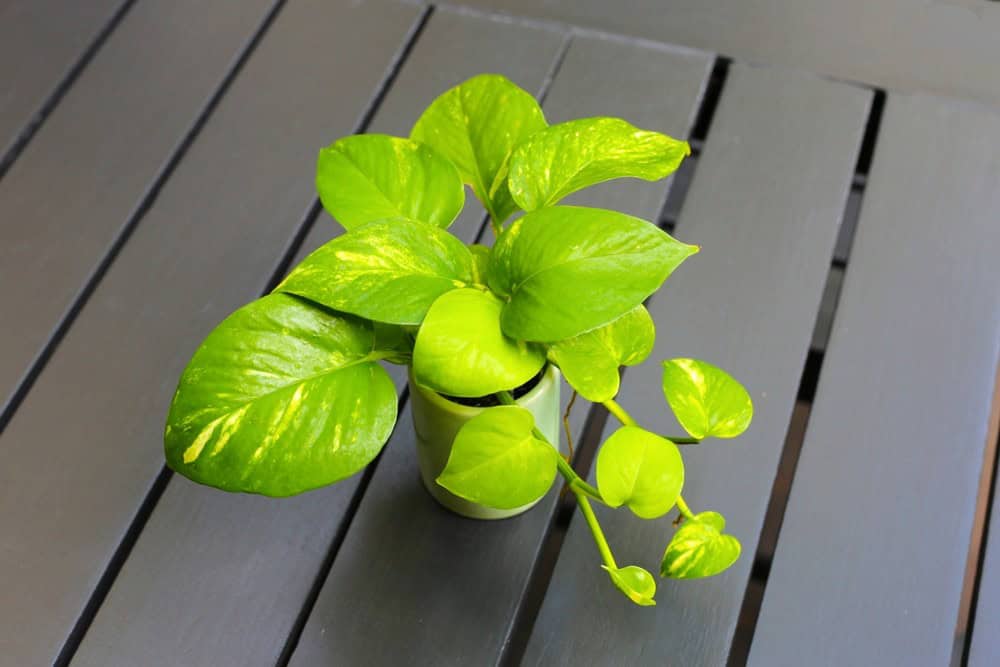
Pothos varieties (or devil’s ivy) are popular as indoor houseplants, and rightly so! They’re (mostly) low-maintenance and adaptable, and come in an incredible range of colours and patterns.
From the beginner-friendly golden pothos to the rare and striking Manjula, there’s a variety to suit every plant parent. Their vines can trail or climb, adding lush greenery to your space.
Like other aroids, they prefer bright, indirect light with typical indoor humidity (at least 45%) and warm environments (18–30ºC). Variegated types need more light to maintain their colouring, while solid green varieties are more tolerant of lower light.
Ready to get into the weeds of the different pothos types? Here are some of the top varieties to make your home look devilishly good.
Pothos Varieties Chart
| COMMON | CULTIVARS AND MUTATIONS | UNIQUE | RARE |
| Golden pothos | Global Green | Baltic Blue | Harlequin |
| Marble Queen | Jessenia | Cebu Blue | Manjula |
| Neon | Pearls and Jade | Dragon’s Tail | Skeleton Key |
| N’Joy | Snow Queen | Shangri-La | |
| Silver pothos |
More to Know About Pothos Plants
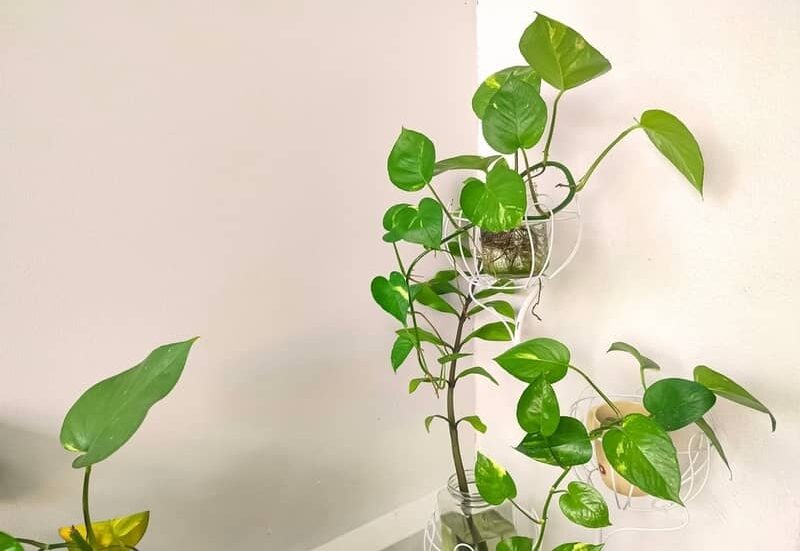
The devil’s ivy or pothos (Epipremnum aureum) is a popular houseplant, and for good reason! They’re mostly low-maintenance plants, with foliage that adds colour and character to a room.
The nickname “pothos” comes from the plant’s original classification in the 1800s, when it was classed as Pothos aureus. Nowadays, it is the E. aureum, though you may see it in nurseries as Scindapsus aureus or E. pinnatum ‘Aureum’.
Pothos are aroids just like monsteras, philodendron, and aglaonemas. They’re tropical plants native to French Polynesia, but have become naturalised in other regions. That rainforest background is part of what makes them so easygoing at home!
When caring for devil’s ivy, give it bright, indirect light with moderate humidity and warm temperatures. It’ll also need space to stretch — those heart-shaped green leaves grow on vines that can reach up to 3.0m in length!
NOTE: All parts of a pothos contain calcium oxalate crystals, which are toxic if licked or ingested. Keep your plant out of reach of pets or curious children.
How Can I Tell What Kind of Pothos I Have?
Got an unlabelled pothos or a cutting you can’t identify? There are a few things to look out for that tell you what type of pothos it is.
First off, let’s talk about terminology. You may encounter 3 different terms when it comes to pothos plants: variety, cultivar, and sport.
“Variety” and “cultivar” are often used interchangeably, but “cultivar” comes from “cultivated variety” — so a plant with characteristics bred by humans. A “sport” is a plant that begins from a natural mutation on a single branch or shoot of a variety/cultivar.
The Pearls and Jade, for example, is a sport of the Marble Queen cultivar. But whichever the origin of your plant, the real identification comes from looking at its features!
LEAF COLOUR: Foliage is the first, most useful clue. The primary colour and variegation will point you towards the most likely variety or cultivar. Creamy-white marbling means Marble Queen, while uniform lime green screams Neon!
LEAF SHAPE: Most E. aureum varieties will have waxy, heart-shaped leaves, but some are more unique. The Manjula has wavy edges that don’t lie flat, for example. Long, arrow-shaped foliage indicates E. pinnatum varieties.
FENESTRATIONS: It’s rarer, but there are pothos plants with fenestrated (split) leaves, like Monsteras! Baltic Blue, Cebu Blue, and Dragon’s Tail can produce fenestrations when mature and in the right conditions.
Keep in mind, though: light conditions can affect the appearance of foliage. Less light leads to less variegation, or can cause the plant to revert to plain dark green foliage. That can make it harder to identify your plant until it gets more sunshine!
Common Pothos Varieties In Australia
These are the types of pothos you’ll likely find in your local nursery, garden centre, or online shop.
Hardy and forgiving, these varieties are perfect for both beginners and experienced plant parents.
Golden pothos
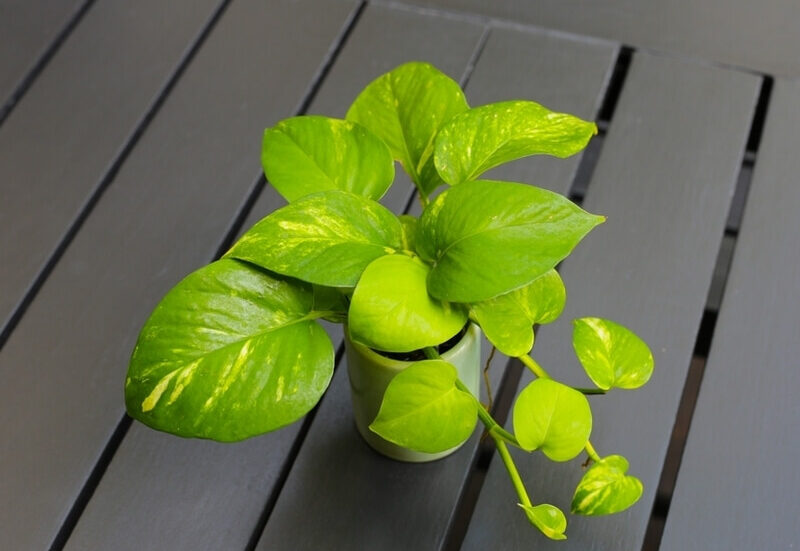
Scientific Name: Epipremnum aureum
Leaf Colour: Green with yellow splashes
This is the most classic of pothos types, the golden pothos!
It has heart-shaped, medium green leaves with yellow splashes. The plant can tolerate a range of light conditions, but does best in bright, indirect light.
Like most pothos varieties, the golden pothos is a vining, climbing plant. You can let it trail out of a pot or hanging basket, but you’ll get bigger leaves if you give it something to climb!
The Hawaiian pothos (E. aureum ‘Hawaiian’) is a cultivar with larger leaves and lighter, creamier variegation. If you want a similarly hardy and fast-growing variety, look for the solid green Jade pothos!
Marble Queen pothos
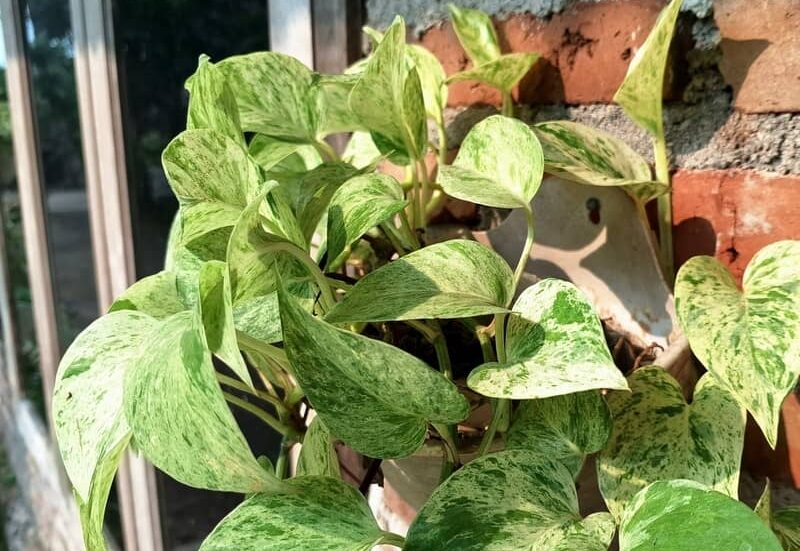
Scientific Name: E. aureum ‘Marble Queen’
Leaf Colour: Green with heavy white splashes
With its heavier variegation, the Marble Queen pothos is more of a challenge. The foliage has a dark green base with splashes and streaks of creamy-white.
Since it’s so variegated, this plant should get medium to bright light! Low light conditions may cause it to lose its colour and revert to plain green foliage.
The lack of green does mean the Marble Queen can’t photosynthesise as easily, so it grows more slowly than other pothos plants.
Neon pothos
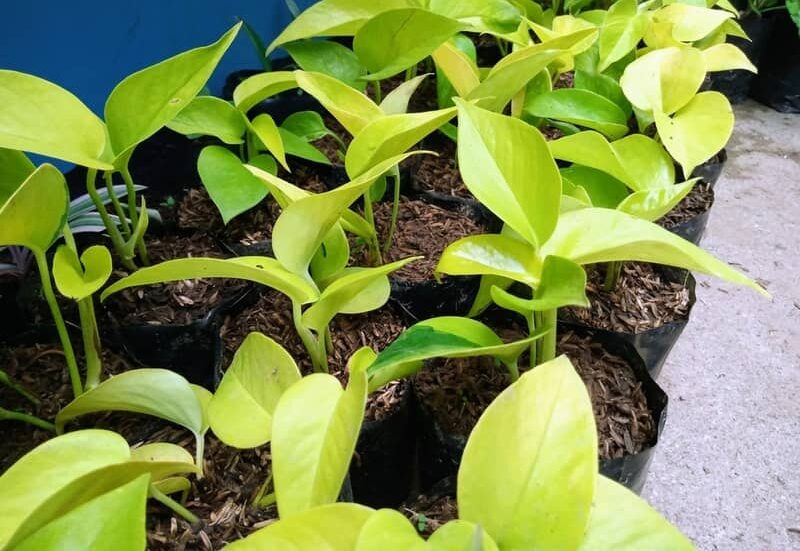
Scientific Name: E. aureum ‘Neon’
Leaf Colour: Bright golden or yellow-green leaves
The Neon pothos has gained popularity over the years, thanks to its distinct colouring. Much like the Lemon Lime philodendron, this pothos has a mix of light green, lime green, and bright golden leaves — hence the nickname Neon!
(Since the Lemon Lime is sometimes called the neon philodendron, the two plants are often confused with each other.)
To maintain its coloured foliage, keep your plant in a brightly-lit spot. Low light causes darker, duller leaves, though leaves may also darken as they age.
There is a variegated cultivar (E. aureum ‘Neon Variegata’) with electric yellow splotches on the neon green leaves.
NOTE: In Australia, you’ll often find this sold as “Goldilocks Pothos”!
N’Joy pothos
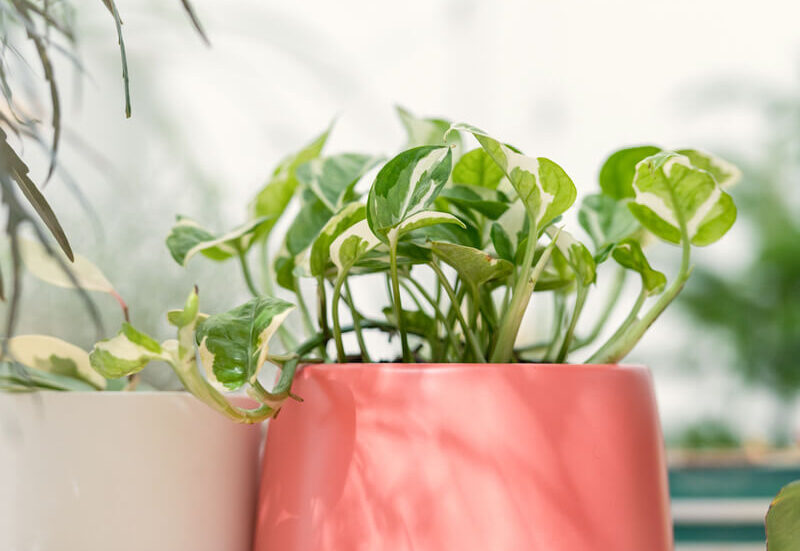
Scientific Name: E. aureum ‘N’Joy’
Leaf Colour: Shades of green, silver, and cream marbling
If you’re looking into variegated devil’s ivy, the N’Joy pothos is a great place to start. It has fairly stable colouring, with blotches of green, silver, and cream on its foliage.
It’s a sport of a Marble Queen clone, and was reportedly discovered at a greenhouse in India in 2002.
This variety makes a great tabletop or bookshelf plant, since it has smallish leaves with a “painted” look. Just make sure it has enough bright, indirect light to keep the variegation!
Don’t let your N’Joy dry out too much, though — the foliage will wilt, causing the plant to look sickly. Fortunately, it recovers quickly after watering.
NOTE: In Australia and other regions, you might see these sold under the “Snow Queen” label. Check the leaves or ask the nursery to be sure!
Silver pothos
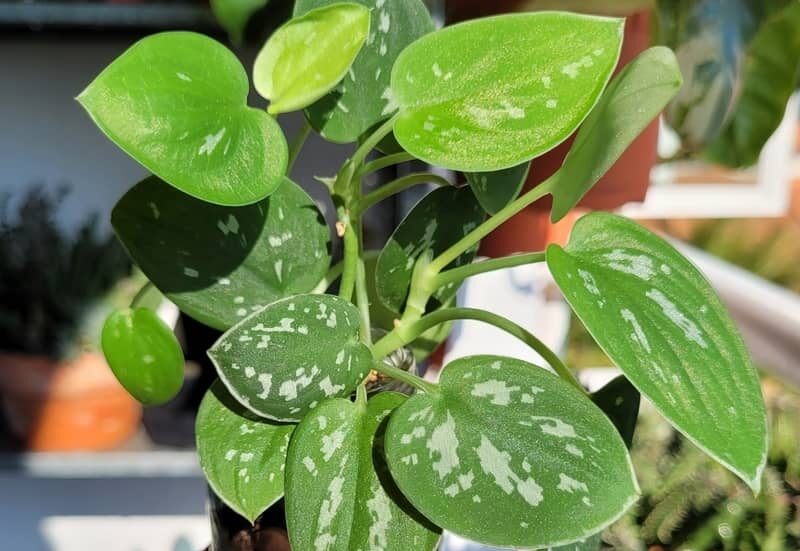
Scientific Name: Scindapsus pictus
Leaf Colour: Dark green with silver blotches
This is not a true pothos, but is sold under names like silver pothos or satin pothos! The plants are very similar, though, and true pothos was previously classified as a Scindapsus as well.
You can identify the silver pothos by its dark green leaves with silver-grey blotches. The foliage will have a “border” in a similar colour along the edges.
Popular S. pictus cultivars include S. pictus ‘Exotica’ (silver satin pothos) or S. pictus ‘Silvery Ann’ (Silvery Ann pothos).
Pothos Cultivars and Mutations
Beyond the “classic” varieties, plant growers have discovered an array of special cultivars and spontaneous mutations.
These pothos types have striking colour patterns or leaf characteristics that set them apart from their parent plants. Many were discovered as “sports” (unexpected mutations) that have been patented and propagated to replicate their distinct features.
Note that some patented cultivars (like Global Green or Pearls and Jade) may be difficult to find in Australian nurseries and shops.
Global Green pothos
Scientific Name: E. aureum ‘Global Green’
Leaf Colour: Mottled dark and light green
The Global Green pothos is a fairly new, patented cultivar with unique, two-toned foliage. The leaves are dark green with blotches of chartreuse near the centre!
Since it lacks pale or white variegation, it’s more tolerant of medium to low light.
You may also encounter the Lemon Meringue, a patented sport of Global Green that has light green to golden variegation along the edges.
Jessenia pothos
Scientific Name: E. aureum ‘Jessenia’
Leaf Colour: Green and yellow-green variegation
Discovered by Costa Farms, the Jessenia pothos is a sport of the Marble Queen! It’s named after the daughter of the grower who found it.
The signature heart-shaped, green leaves have splashes of light green or chartreuse. In contrast, the Marble Queen will have creamy-white variegation.
Jessenia plants have a stable variegation, so they can tolerate low light, but will thrive most in medium to bright, indirect light. The plant grows more slowly than unvariegated pothos types.
Pearls and Jade pothos

Scientific Name: E. aureum ‘UFM12’
Leaf Colour: Cream to white variegation with green flecks
The Pearls and Jade pothos is a patented cultivar from the University of Florida. It resembles the N’Joy, featuring dainty, green leaves and cream-to-white blotches.
You can tell it apart from the N’Joy and Marble Queen since the Pearls and Jade has wavy or undulated leaves, unlike the N’Joy (smooth, waxy surface). It also has 3 distinct leaf colours (green, grey-green, and cream-white) while the N’Joy has several shades.
While some sources mention looking for green flecks in the variegation, this characteristic isn’t specified in the official patent!
Like other variegated pothos, Pearls and Jade prefers brighter light and grows quite slowly.
Snow Queen pothos

Scientific Name: E. aureum ‘Snow Queen’
Leaf Colour: Cream to white foliage with green streaks
The Snow Queen pothos is even more heavily variegated than the Marble Queen! Most of the foliage will be white to cream, with streaks or splotches of green.
There’s plenty of debate on whether the Snow Queen is a distinct cultivar or just a very highly variegated Marble Queen. Still, many nurseries will sell it as its own plant.
This cultivar will need plenty of bright light to keep that heavy variegation. Too little light and the plant will revert or put out greener foliage for better photosynthesis. But too much direct sunlight and the leaves might scorch, so be careful!
Moreover, since the Snow Queen has less chlorophyll, it’s more delicate and recovers more slowly from issues like root rot.
Unique Pothos Varieties
Now, here are some types of pothos that truly break the mold. These varieties showcase the diversity of the pothos family, from blue-tinged foliage to unusual leaf forms.
Availability can be limited, especially in Australia — you’ll mostly find these in specialty nurseries or online retailers. But their unique appearances make them worth the effort!
Baltic Blue pothos
Scientific Name: Epipremnum pinnatum ‘Baltic Blue’
Leaf Colour: Dark green leaves with blue undertone
This is also not a “true” pothos, but it’s more closely related! The Baltic Blue pothos also falls under the Epipremnum genus, though it’s a different species.
E. pinnatum has a naturally varied appearance, and the Baltic Blue cultivar was propagated from a strain that had more blue than usual. A Costa Farms grower discovered the strain in the wild!
This species is particularly unique since it can develop fenestrations like a Monstera — when mature, and in the right conditions. The plant needs plenty of bright, indirect light and a warm environment.
The Baltic Blue can be a climbing or trailing plant, and its deep green foliage develops a blue tone as it matures.
Cebu blue pothos

Scientific Name: E. pinnatum ‘Cebu Blue’
Leaf Colour: Dark green leaves with silvery-blue sheen
This E. pinnatum variety gets its name from its native island of Cebu in the Philippines!
Like the Baltic Blue, the Cebu Blue pothos can also develop fenestrations when mature. But this variety is unique for its foliage, which has a metallic sheen on its blue-green leaves.
The foliage is also narrower and more arrow-shaped than a typical pothos. To encourage larger leaves with fenestrations, give the plant something to climb!
Cebu Blue is still fairly uncommon, but it’s becoming more available thanks to its growing popularity and is showing up in several Aussie nurseries.
Dragon’s Tail pothos
Scientific Name: E. pinnatum
Leaf Colour: Medium green foliage
Did you know there’s a pothos variety native to Australia? The Dragon’s Tail pothos (or Dragon Tail plant) is endemic to parts of Asia and Australia, and is iconic for its pointed, narrow leaves — like a dragon’s tail!
E. pinnatum has small, thin foliage when grown indoors, but under the right conditions, a mature plant will produce larger leaves with fenestrations. Give your plant plenty of sunlight and a structure to climb.
Unvariegated Dragon’s Tail plants are more low-light tolerant, while variegated types can be prone to drying or leaf scorch.
Shangri-La pothos
Scientific Name: E. aureum ‘Shangri-La’
Leaf Colour: Crinkled or curled leaves
This is perhaps the most unusual pothos variety — the Shangri-La or Sleeping pothos.
The Shangri-La pothos was developed by Teruno in Japan. It has dark green leaves (sometimes variegated with yellow) that stay crinkled and curled up instead of unfurling fully!
Thanks to the twisty leaf shapes, the plant brings a unique look to any space. It’s also given the plant its other nickname, Spinach Pothos.
Shangri-La pothos is still somewhat uncommon outside Japan, but if you find one, give it something to climb so it thrives. Just be patient, though, as it’s pretty slow-growing!
Rare Pothos Varieties
These varieties are prizes for plant collections since they’re a challenge to find. But they offer truly special aesthetics, from stark white variegation to dramatic fenestrations.
Don’t expect to find these at your local garden centre; these varieties often come from specialty nurseries or plant swaps with fellow collectors.
Harlequin pothos
Scientific Name: E. aureum ‘Harlequin’
Leaf Colour: Extreme white variegation
This is similar to the Snow Queen and Marble Queen plants! The Harlequin pothos is an extremely variegated version of the Manjula, with majority-white colouring and dark green marbling or edges.
Like any highly-variegated plant, it needs a well-lit spot to maintain the colour. But don’t expose it to direct sunlight (especially in the afternoon) or the delicate leaves may get burned.
That extreme variegation is what makes the Harlequin so rare. The lack of chlorophyll means it’s difficult to propagate, and there’s no guarantee the new plant will carry the same colouring.
Manjula pothos

Scientific Name: E. aureum ‘HANSOTI14′
Leaf Colour: Shade of cream, light green, silver, and white
This is another patented variety, recognisable for its multi-coloured variegation. The Manjula pothos has creamy, yellow-white foliage marbled with shades of green.
Unlike many variegated plants, there’s typically not a clean border between colours — instead, you’ll get varying sizes of flecks, patches, and splashes.
Manjula pothos plants also typically have wavy edges, so the leaves don’t lie flat.
When looking for a Manjula for purchase, you may also see it sold under its other nickname, Happy Leaf!
Skeleton Key pothos
Scientific Name: E. pinnatum ‘Skeleton Key’
Leaf Colour: Medium to deep green foliage
This is another E. pinnatum variety, the Skeleton Key. The name comes from the mature form, as the foliage can develop deep lobes or splits, making it resemble, well… a skeleton key!
The plant is fairly low-maintenance, happy with bright light and warm temperatures. However, getting it to mature into those signature leaves is difficult — it needs just the right combination of light, warmth, humidity, and support.
If you find this in a nursery or online shop, it’ll be sold in its juvenile form, without the lobes.
FAQs About Pothos Varieties

Still have questions about pothos plants? We’ve gathered some common queries and concerns that plant parents might have!
How many kinds of pothos are there?
There are about 15 different species in the Epipremnum genus, and about 15–20 commonly recognised varieties or cultivars of Epipremnum aureum, or the “true pothos”!
E. aureum is the most common houseplant variety, with popular cultivars including the Neon, N’Joy, and Marble Queen. But you can also find related plants like E. pinnatum (Cebu Blue and Baltic Blue) that are called pothos as well.
Which pothos is best for beginners?
The golden pothos is one of the easiest pothos varieties to care for, and for good reason. It’s hardy and low-maintenance, and can bounce back if you’re late to watering.
Golden pothos also has a fairly stable variegation, so it can maintain its colouring even in lower light conditions. (Though keep in mind, too-low light will cause any variegation to fade.)
Other pothos plants good for beginners are the Neon and N’Joy varieties.
Skip cultivars like the Snow Queen or Manjula, which require more light and consistent care to look their best!
Which pothos grows the fastest?
Golden pothos again takes the crown here! It’s one of the fastest-growing pothos varieties available, adding as much as 30–45cm per month in the growing seasons.
In general, solid green or lightly variegated varieties will grow faster since they absorb more chlorophyll for photosynthesis.
So varieties like the Jade pothos are among the fast growers, while heavily variegated cultivars like Marble or Snow Queen will grow more slowly.
What is the rarest pothos?
The Harlequin pothos (E. aureum ‘Harlequin’) is one of the rarest pothos varieties!
It’s believed to be a highly variegated form of the Manjula (so not a distinct cultivar), and is prized for the dramatic contrast between the bright cream and dark green on the leaves.
The rarity comes partly from the difficulty in propagating this plant. The lack of chlorophyll means it can struggle to root, and the new plant may not have the same prominent colour.
Can I propagate all pothos varieties?
Pothos plants are easy to propagate, but some are protected by plant patents, so they’re not allowed to be propagated for sale or trade without a license.
Cultivars that have been patented include the Pearls and Jade, Global Green, Lemon Meringue, and Manjula. It’s generally fine to propagate these for personal use (say, making more plants for yourself), but there are restrictions around selling or swapping cuttings.
Is the satin pothos a pothos variety?
Despite its name, the satin pothos (also silver satin pothos or silver pothos) is technically not a true pothos! It’s a member of the Scindapsus genus instead of Epipremnum.
The confusion stems from their original plant classifications. Epipremnum aureum used to fall under Scindapsus, before researchers separated it into its own genus.
Visually, though, they appear very similar, so S. pictus keeps its “pothos” nickname!
Are pothos and philodendron the same?
Pothos and philodendron plants are often mistaken for each other due to their vining habit and heart-shaped leaves. However, while they are related, they’re not the same plants!
Both pothos and philodendrons belong to the Araceae family (aroids). The easiest way to tell them apart is the leaf growth — pothos leaves unfurl from the tip of a vine, while philodendron leaves emerge in a thin protective sheath (cataphyll) that falls away as the leaf opens.
Moreover, pothos plants typically have thick, waxy foliage, while philodendron foliage feels softer and more velvety.
