
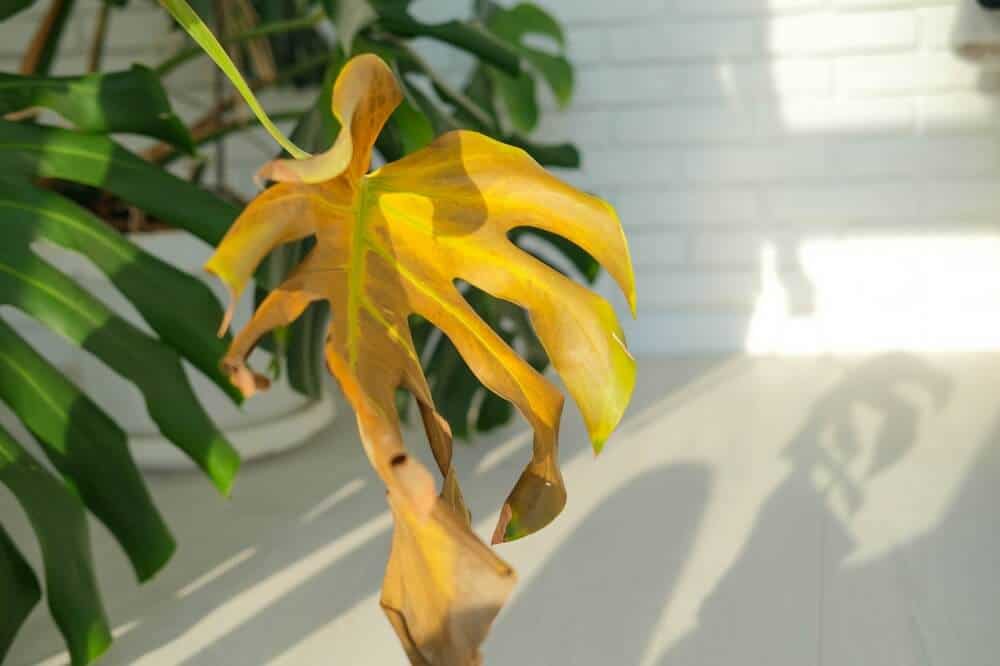
One of the best things about a healthy Monstera is the lush, glossy green foliage. On big Swiss Cheese plants, those gorgeous fenestrated leaves could be as big as your head!
Conversely, one of the nightmares of plant parents is a Monstera with wilting or curling leaves. Your plant’s foliage is usually the first indicator that it’s unhappy.
Common reasons for Monstera leaves curling include:
- Shock
- Underwatering
- Root rot
- Sun exposure
- Low humidity
- Temperature stress
- Pests
- Nutrient deficiencies
Curling foliage is your Monstera’s way of leaf-ing you a clue (ha!) that something’s wrong. With a little detective work, you can get your plant back into shape.
What Monstera Leaf Curling Means

Curling leaves on a Monstera plant are one of the clearest signs that something is off. And how they curl can tell you a lot about the issue!
Once you’ve narrowed down potential causes, the problem gets easier to fix.
Why are my Monstera leaves curling inward?
When Monstera leaves curl inwards, it’s usually a sign of dryness — either underwatering or a lack of humidity.
Dry conditions lead to moisture loss in leaf cells. The Monstera foliage turns brown and brittle, so the leaves curl into themselves in an attempt to conserve moisture.
Why are my Monstera leaves curling down?
Monstera leaves that curl downwards are usually a sign of stress, whether from heat, overwatering, or lack of nutrients.
The cells inside the leaves become weak and damaged, so they cannot support the structure of the foliage. That causes the leaves to turn thin, then curl and droop as gravity pulls them down.
Why are the tips of Monstera leaves curling?
If you see Monstera leaf tips curling and turning brown, it’s likely sunburn or a lack of nutrients (like potassium).
What Causes Monstera Plant Leaves Curling?

You get Monsteras with curling leaves when the plant is unhappy. The reasons range from improper watering to direct sunlight exposure to pests.
Knowing the reason makes it easier to fix curling leaves on a Monstera and help your plant recover.
Also, keep in mind it’s often too late to save curled leaves if they’ve begun to turn yellow or brown. In that case, let them fall off naturally and focus on caring for the plant to prevent further issues.
Shock
Newly-repotted Monsteras or ones moved to a new space may undergo shock.
Things like disturbing the roots or changing the environment can stress the plant, leading to transplant shock. Signs include several curling or yellowing leaves.
Don’t panic! Your plant is currently in “survival mode” as it adapts to its new environment, so it’s recycling nutrients and energy from older leaves.
HOW TO FIX IT:
When repotting Monsteras, handle the roots gently and disturb them as little as possible. Water the plant well in its new container, then make sure it gets lots of indirect light and air circulation.
If you’ve brought home a new Monstera or moved one to a new spot (like a balcony), let the plant acclimate slowly. Don’t introduce too many changes at once — just think about how it’d feel if that happened to you!
Underwatering
Monsteras can’t store water, so if the soil stays dry for too long due to underwatering, the foliage loses moisture and structure.
Underwatered Monsteras have leaves that turn brown and brittle, while curling inwards. The dryness typically starts at the tips and spreads. If the plant has been underwatered too long, the roots may also start withering.
Check the potting mix as well — if it feels hard and rough, it’s dehydrated! In severe cases, the soil has become hydrophobic and can no longer retain moisture.
HOW TO FIX IT:
With underwatered plants, it’s important to carefully rehydrate the soil. In its current state, water may fail to penetrate or the roots can struggle to absorb moisture.
Place the pot inside a larger container and add room-temperature water up to the halfway mark. Let your Monstera sit and take in water through the drainage holes.
After a few hours, lift out the plant and let any excess water drain. Monitor the Monstera afterwards; if the soil keeps drying out quickly, you need to change it.
Root rot

If your Monstera leaves are drooping and curling, as well as turning yellow, the culprit could be root rot.
This is a fungal disease caused by Phytophthora, and it occurs when the soil stays soggy for prolonged periods.
Common reasons for rot include:
- Overwatering (watering too often)
- Pots with few to no drainage holes
- Dense, heavy soil with poor drainage
Rainy, humid, or cool weather can also lead to potting mix drying out more slowly than usual.
HOW TO FIX IT:
You’ll need to check the roots of your plant! Carefully remove it from the pot and brush off some soil. If the roots are dark, stringy, and mushy, that indicates rot.
Cut off all affected roots with a disinfected pair of shears, leaving only growth that’s white and firm. Rinse off the infected soil as well, and wash the pot with hot, soapy water.
Repot the Monstera in fresh, well-draining soil and a container with drainage holes. Wait a few days before watering.
If the plant is too far gone, though, save any healthy stems so you can propagate your Monstera.
Too much direct sunlight
In the wild, Monsteras are understory plants, growing up the trunks of large trees or along the ground underneath. That means they see a lot of bright, dappled sunlight.
Prolonged exposure to direct sunlight, especially in the afternoon, can cause sunburn on foliage. The leaves dry out, turning brown and curling as they become brittle.
Variegated Monstera cultivars, like the Monstera deliciosa ‘Thai Constellation’ or ‘Albo’, are particularly prone to sunburn.
HOW TO FIX IT:
Your Monstera wants plenty of bright, indirect light, around 30cm away from a north- or northeast-facing window in Australia.
If you don’t have a good window as a light source, consider a full-spectrum grow light!
Very low humidity
Monsteras prefer moderate to high humidity levels (around 50% or higher), since they supplement moisture through aerial roots. Still, they can tolerate levels even down to 45% with proper watering.
At around 40% humidity and below, though, the air is too dry for your Monstera! The plant starts losing moisture, causing the leaves to curl inwards.
HOW TO FIX IT:
To increase humidity, consider running a humidifier in the room or placing your plants inside an indoor greenhouse. You can also group plants close together for a little boost.
Avoid misting your Monstera to try and increase humidity! You’ll end up with wet leaves that could rot, especially if they haven’t unfurled yet, and it doesn’t raise the moisture content of the air.
Temperature stress
As tropical plants, Monsteras thrive in warm environments between 18ºC and 30ºC. But too-low or too-high temperatures stress the plant, so leaves become thin and curled.
Other symptoms include dry edges and crinkled foliage.
HOW TO FIX IT:
Avoid exposing your Monstera to temps below 15ºC, or to drafts from vents and air-conditioners. If you keep your plants on a balcony, bring them indoors during winter!
On the other hand, proximity to glass items like windows and tables can reflect sunlight onto your Monstera and cause it to overheat. Summer temps over 35ºC also affect plants.
Pest infestations
Sap-sucking pests can lead to curling Monstera leaves, since the weakened foliage stops being able to hold its shape.
Here are some common pests on indoor plants and their symptoms:
| PEST | SYMPTOM | TREATMENT |
| Aphids | Tiny, light-coloured dots; sticky residue on foliage | Rinse off with water; spray with insecticidal soap or neem oil |
| Spider mites | Tiny, dark specks; white webbing on leaves and petioles | Wipe off mites with cotton bud and rubbing alcohol; spray with mix of rubbing alcohol and water |
| Thrips | Small, light-coloured insects in soil; brown or silver spots on leaves; misshapen new growth | Spray with insecticidal soap, neem oil, or systemic insecticide |
HOW TO FIX IT:
Besides treatment, prune off any affected foliage and dispose of it properly (no composting!). Quarantine infested Monsteras away from other plants so the pests don’t spread.
Make sure you regularly inspect your Monstera’s foliage and soil for pests. Early detection can save you a headache and prevent them from becoming a bigger problem.
Nutrient deficiency
Indoor plants like Monsteras need fertiliser to grow and thrive. Good houseplant fertiliser has a mix of nitrogen, phosphorus, and potassium (called NPK).
If your plant lacks certain nutrients, it can show stunted growth and other symptoms like:
- Nitrogen deficiency: Curling, yellowing lower leaves with brown spots
- Phosphorus deficiency: Curled lower leaves and discolouration
- Potassium deficiency: Curled and discoloured leaf tips
A lack of nutrients usually comes from old soil (over 2 years), inadequate fertiliser, or compacted soil (which prevents nutrient absorption).
HOW TO FIX IT:
If you haven’t changed your Monstera’s soil in 1–2 years, now’s the time to repot with fresh potting mix! You also get to check if it’s rootbound and can go up a pot size.
Additionally, use a balanced houseplant fertiliser every 4–6 weeks during the growing season (spring and summer). Look for one with a 20-20-20 NPK ratio.
Regular fertilising contributes to healthy plant growth, giving you big, lush foliage.
Tips to Keep Monstera Leaves Healthy

It’s not the end of the world if your Monstera’s leaves are curling! There are ways to treat your plant and help it recover.
That said, repeated stress or poor growing conditions lead to unhappy plants. Care for your Monstera properly to prevent leaf curling and other issues.
Ensure your plant gets adequate light, whether by a window or a full-spectrum grow light. Position it somewhere well-ventilated and keep it away from cold drafts or heat.
For watering, it’s better not to stick to a schedule! Instead, water the soil when it’s mostly dry. You can test the moisture levels with your finger or a wooden stick.
A few curling leaves aren’t too bad, but if you’re seeing a lot of unhealthy foliage, you may need to prune the affected Monstera stems so the plant can start over.
Monsteras are pretty forgiving plants! Catch any early signs, and they’ll bounce back from leaf curl (or other issues) with vibrant, healthy foliage.
